
Nigeria’s Transport System awaits Major Transformation as GTP Steps Out for a World Class Multimodal Event on Wednesday

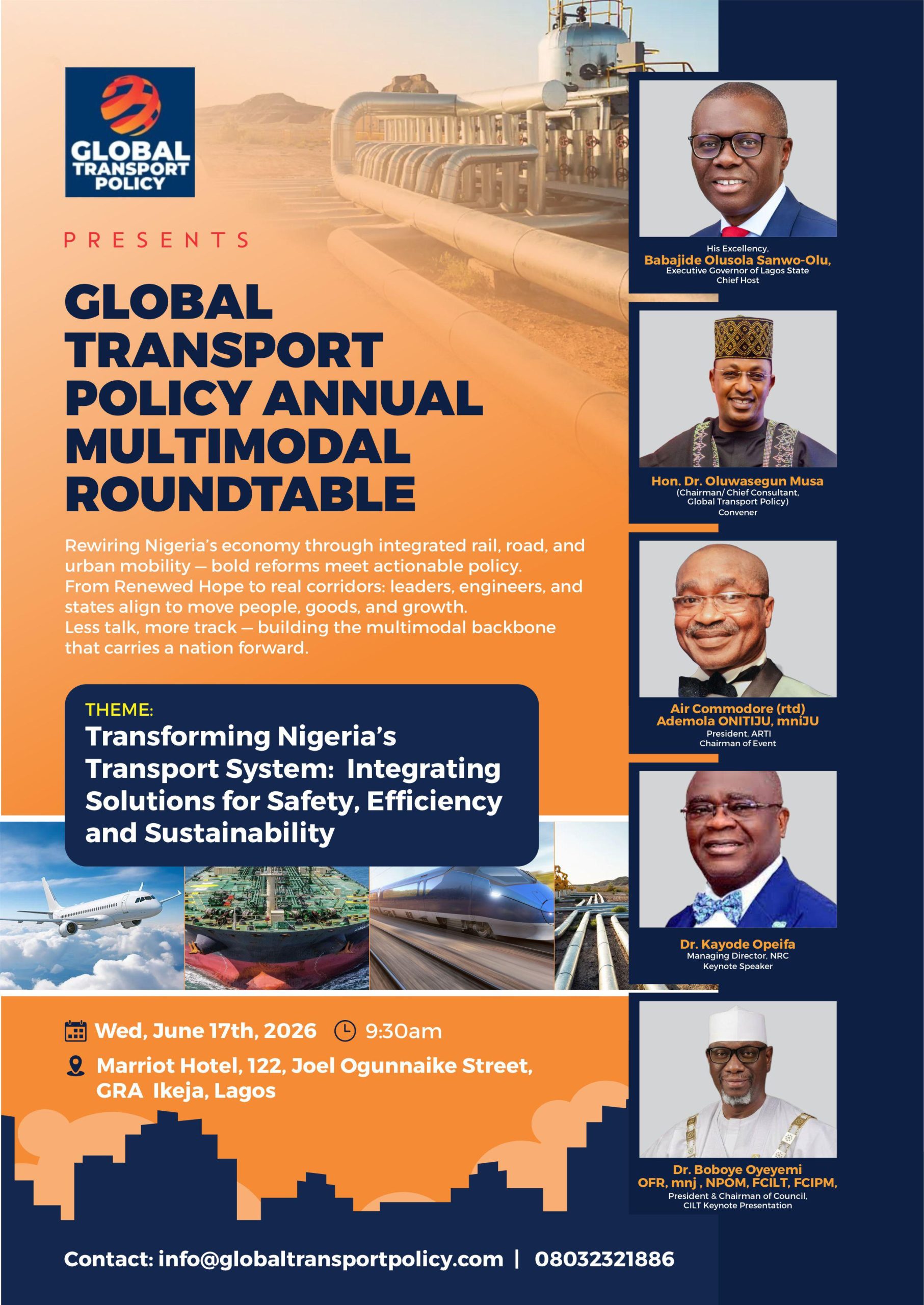
By: James Shodiya -The GTP Annual Multimodal Roundtable Conference is set to hold today Wednesday June 17, at the prestigious Marriott Hotel with personalities from all walks of life strolling in.
Dignitaries, technocrats, silicon valley founders, government representatives, academia, industry doyen, media and many more are expected to grace the occasion.This edition promises to be provocative, insightful, challenging and innovative.
Global partners to attend the event include the European Union (EU), Africa Union (AU), the Africa Development Bank (AfDB), Economic Community of West Africa States (ECOWAS) and others.
Dolling out tips at a press briefing on what to expect at the conference the Chief Consultant Global Transport Policy (GTP), Dr. Segun Musa said it would address barriers holding back the full implementation of a workable multimodal transport system.
He highlighted that one of such challenges include lack of policy drive, political will, technocrats to superintend over the agencies assigned to multimodalism.
Dr. Musa stressed that in an effective multimodal architecture technocrats can proffer solutions without setting up committees.
He cited a Nigeria-specific example where in the 60s to mid 90s cargo could move seamless across rails from the hinterland to cities with ready-buyers waiting along the lines to purchase and distribute commodities to markets and doorsteps.
The transport expert bemoaned the current state of transportation where perishable goods are lost in transit due to decay.
This predicament makes producers transfer the cost of perished items to healthy produce.
Consequently, the cost of transport affects the cost of commodities in the market.
In his words: “If we can have the opportunity to position transport effectively, definitely it will enhance our supply chain.”
Delving into agriculture, the Chief Executive Officer of Widescope Logistics International, Dr. Musa stressed that the reason many people are not farming is because Nigeria does not have an effective transport system. Until we begin to have an effective transport system before we have people willing to go back to farm and cultivate more; and that is how we can fulfill our food security, he maintains.
Continuing on the nationwide predicament of food shortage, Musa iterated that, “If we have to use our own organic food then we must have effective transportation that will encourage farmers to go back to farm; because production has highly reduced in Nigeria.”
He highlighted that manufacturing was not spared as fewer people are now involved in manufacturing.
Following the high cost of production: transporting raw materials, equipment and spare parts to production sites, consumers now prefer imported produce which is cheaper. We have people that want to go into manufacturing and production but if we don’t have effective transport system that will enhance the supply chain distribution then it will always end up frustrating.
According to him, we need to look at what are the forces causing hyper inflation in Nigeria. Why are people not able to purchase commodities in the market? he quizzed.
On a last note, “Until we get transport right we won’t get any other thing right,” he concluded.