
Beyond Bricks and Mortar: Why Nigeria’s Real Estate Future Depends on Integrated Governance, Environmental Sustainability, and Urban & Regional Planning


 By Kesiena Onaibe Real Estate Investment Advisor | Urban Development Practitioner
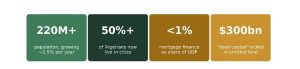
Nigeria’s housing challenge in four numbers.
Executive summary.
Nigeria’s housing debate is dominated by a single number, a deficit of somewhere between 17 and 28 million units, yet the number itself is a symptom, not the disease. The deeper problem is systemic: governance, spatial planning, environmental stewardship, and real estate development operate as four disconnected silos when they should function as one system. With the population past 220 million and growing at about 2.5% a year, urbanisation already across the halfway mark, formal housing output stuck below 100,000 units a year, and mortgage finance under 1% of GDP, the country cannot build its way out of the problem one estate at a time. This paper argues that Nigeria’s real estate future will be decided less by how many buildings rise than by whether the institutions, plans, and environmental safeguards behind them are integrated. The question is no longer whether we can build more. It is whether we can build smarter.
Introduction
Nigeria’s real estate sector is far more than an avenue for property investment; it is a catalyst for economic growth, social inclusion, and national development. Every residential estate, commercial district, industrial park, and transport corridor influences how cities function, how businesses thrive, and how communities interact. Yet despite the sector’s enormous potential, Nigeria continues to grapple with a housing deficit estimated at anywhere between 17 and 28 million units, depending on the source and methodology, alongside rapid urbanisation, weak planning institutions, inadequate infrastructure, and mounting environmental vulnerabilities.
The imprecision of that deficit range is itself part of the story. Estimates from UN-Habitat, the Central Bank of Nigeria, the Federal Mortgage Bank of Nigeria, and the World Bank have circulated at 17, 20, 22, and 28 million units, often used interchangeably and rarely distinguishing between the quantitative shortage of units and the qualitative inadequacy of existing stock. When a country cannot state the size of its housing problem with confidence, it is very difficult to finance, plan, or build the solution. The data gap is not a footnote; it is a governance failure with direct consequences for policy and investment.
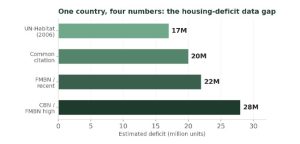
Figure 1. Widely cited housing-deficit estimates diverge by more than ten million units.
The scale of demand behind that deficit is not in doubt. Nigeria’s population now exceeds 220 million, making it Africa’s most populous nation, and it is growing at roughly 2.5% a year, on a trajectory the United Nations projects will approach 400 million by 2050. Urbanisation has already crossed the halfway mark, with more than half of Nigerians now living in cities. Each year, millions migrate to urban centres in search of economic opportunity, placing unprecedented pressure on housing, transport systems, public utilities, and social infrastructure. Unless cities are strategically planned and effectively governed, this growth risks deepening congestion, informal settlements, environmental degradation, and infrastructure deficits rather than generating sustainable prosperity.
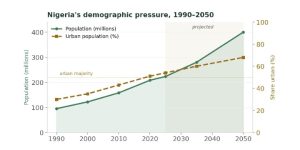
Figure 2. Population and urbanisation both climb steeply through 2050 (shaded years projected).
The challenges confronting the sector are often attributed to insufficient housing supply or inadequate investment. While these are significant constraints, they are symptoms rather than root causes. The more fundamental issue is the disconnect between public governance, environmental sustainability, urban and regional planning, and real estate development. Sustainable cities cannot be built through isolated interventions. They require an integrated framework that aligns policy, planning, environmental stewardship, infrastructure, and market investment.
The scale of the challenge, at a glance
| Indicator | Figure |
| National housing deficit (range across sources) | 17–28 million units |
| Estimated cost to bridge the deficit | ~₦21 trillion+ |
| Units needed per year (Ministry estimate) | ~550,000 / yr for 10 yrs |
| Actual formal delivery per year | Below 100,000 units |
| Population / growth rate | 220m+ / ~2.5% p.a. |
| Share of population in urban areas | Over 50% |
| Mortgage finance penetration | Under 1% of GDP |
| “Dead capital” in untitled land (PwC est.) | ~$300bn (≈60% of GDP) |
Sources: UN-Habitat; Central Bank of Nigeria; Federal Mortgage Bank of Nigeria; World Bank; Federal Ministry of Housing and Urban Development; PwC (2019). Estimates vary by source and methodology.
Real Estate Is More Than Buildings
Real estate should not be measured by the number of houses constructed but by the quality of communities created. Globally, successful cities demonstrate that housing performs best when integrated with transport networks, schools, healthcare facilities, drainage systems, green infrastructure, commercial centres, and public spaces. Urban and regional planning provides this strategic coordination, determining where development should occur, how land should be used, and how future growth should be managed.
In Nigeria, however, urban expansion has frequently outpaced planning. Informal settlements continue to grow, road networks struggle to support rising traffic, drainage systems remain inadequate, and essential public infrastructure often follows development rather than preceding it. The result is inefficient land use, declining urban liveability, and rising costs for governments, businesses, and residents alike. Nowhere is the consequence starker than in flooding: unregulated construction on natural waterways turns ordinary rainfall into disaster, a point the environmental section returns to in detail.
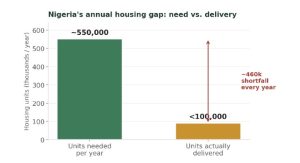
Figure 3. Formal delivery meets only a fraction of annual need, widening the deficit each year.
The affordability squeeze is reaching the middle class. The housing crisis is no longer confined to the urban poor. Across Lagos and other major centres, professionals who once formed the backbone of the middle-income bracket are being priced into smaller, less dignified accommodation, with families squeezed into single-room units and even university lecturers reportedly sleeping in their offices. When a shortage of well-planned, well-serviced housing reaches the salaried middle class, it has stopped being a sector problem and become a national one.
Governance: The Foundation of Sustainable Real Estate
The success of any real estate market depends largely on governance. Public policy shapes land administration, housing finance, zoning, infrastructure investment, taxation, and development control. When institutions function effectively, they provide certainty for investors, protect the public interest, and encourage orderly urban growth.
Nigeria has introduced numerous housing and urban development initiatives over the years, yet implementation remains constrained by fragmented institutional responsibilities, bureaucratic approvals, inconsistent enforcement of planning regulations, and limited coordination across agencies. The land system sits at the centre of the problem. Under the Land Use Act, land is vested in state governors, and title processing is so slow and costly that a large majority of holdings remain undocumented. PwC has estimated that roughly $300 billion, equivalent to around 60% of GDP, is locked up as “dead capital” in land that cannot be easily mortgaged, traded, or used to raise finance. That single governance failure suppresses the mortgage market, deters formal development, and keeps millions of households outside the formal property economy.
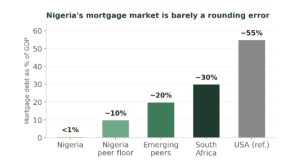
Figure 4. At under 1% of GDP, Nigeria’s mortgage market lags far behind peer and developed markets.
Good governance therefore extends beyond policy formulation. It requires transparent land administration, digital planning and titling systems, efficient development approvals, institutional accountability, and evidence-based decision-making supported by reliable housing and spatial data. The absence of that data, the reason Nigeria’s housing deficit is quoted across an eleven-million-unit range, is itself the clearest illustration of why governance, not construction, is the true foundation of the sector.
Urban and Regional Planning: The Missing Link
Urban and regional planning is perhaps the most underappreciated component of Nigeria’s real estate sector. Planning is not simply about preparing master plans; it is about anticipating population growth, coordinating infrastructure investment, protecting environmentally sensitive areas, improving mobility, and ensuring equitable access to housing and public services.
Without effective planning, housing estates emerge without adequate roads, drainage, schools, healthcare, or public transport. Commercial developments intensify congestion because transport infrastructure is not upgraded in step. Residential communities grow increasingly vulnerable to flooding because natural waterways are obstructed by unregulated construction. Planning is what transforms real estate from a scatter of isolated developments into functional, resilient urban systems, and its weakness is why so much Nigerian development imposes costs on everyone around it.
The remedy is not more plans on paper but planning with authority: the institutional capacity to direct where growth goes, the enforcement to make zoning mean something, and the coordination to ensure that infrastructure leads development rather than chasing it years later. Compact, transit-oriented, mixed-use growth is cheaper to service and easier to make resilient than the low-density sprawl that currently dominates the urban fringe.
Environmental Sustainability Is No Longer Optional
Climate change has fundamentally changed how cities must be developed. Across Nigeria, intensifying floods, erosion, heat stress, waste-management pressures, and biodiversity loss have made clear that environmental sustainability is no longer an environmental issue alone; it is an economic and development imperative.
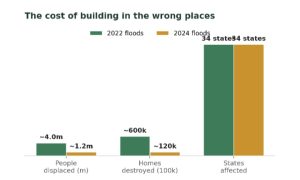
Figure 5. Recent flood seasons have displaced millions and destroyed tens of thousands of homes.
The cost of building in the wrong places. Nigeria is now one of Africa’s most flood-prone countries, a product of climate change, rapid population growth, mismanaged dams, and poor urban planning. The 2024 floods struck 34 of the country’s 36 states, displaced around 1.2 million people, and destroyed well over 100,000 homes; the catastrophic 2022 floods displaced some four million. Ahead of the 2025 wet season, the Nigeria Hydrological Services Agency again warned of severe flooding across much of the country and an urgent need for comprehensive flood-protection measures. Much of this damage is not simply natural, it is the predictable result of building on wetlands, floodplains, and blocked drainage channels.
Developments constructed on floodplains or over natural drainage expose communities to serious risk while inflating future public spending on disaster response and infrastructure rehabilitation. The losses compound: destroyed homes, ruined farmland, contaminated water, and outbreaks of waterborne disease follow major floods with grim regularity. Every naira saved by skipping proper site assessment and drainage is repaid many times over in emergency relief and reconstruction.
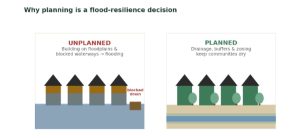
Figure 6. The same rainfall produces very different outcomes depending on whether development is planned.
Environmental sustainability must therefore become an integral part of real estate decision-making through rigorous Environmental Impact Assessments, climate-resilient infrastructure, efficient water and drainage management, renewable-energy adoption, green-building standards, and sustainable land-use planning. The objective is not merely to minimise environmental harm but to create communities capable of adapting to future environmental uncertainty. In practical terms, that means environmental review should function as a genuine gatekeeper to planning approval, not a procedural box to be ticked after decisions are effectively made.
An Integrated Development Framework
Nigeria’s real estate future depends on recognising that governance, planning, environmental sustainability, and real estate are interdependent. Effective governance establishes clear policy and regulatory certainty. Urban and regional planning provides long-term spatial direction. Environmental management protects natural systems while strengthening resilience. Real estate development translates these frameworks into productive communities that support economic growth and improved quality of life.
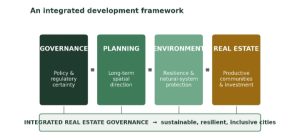
Figure 7. Four interdependent pillars: when one fails, the whole system weakens.
When one component fails, the whole system weakens, and the failures are mutually reinforcing rather than isolated:
- Housing policy without planning produces urban sprawl that is expensive to service and easy to flood.
- Planning without institutional enforcement produces widespread non-compliance and paper master plans that no one follows.
- Development without environmental stewardship multiplies disaster risk and shifts costs onto the public purse.
- Investment without governance discourages the long-term, patient capital that housing at scale requires.
The future therefore lies in Integrated Real Estate Governance: a collaborative framework that aligns policymakers, planners, environmental professionals, developers, financiers, engineers, architects, and local communities around shared development outcomes. Integration is not a slogan; it is the difference between a system that converts demographic pressure into bankable, repeatable supply and one that converts it into slums and flood zones.
The Way Forward
Nigeria has an enormous opportunity to reposition its real estate sector as a driver of sustainable national development. Achieving that vision requires coordinated reform across five fronts:
- Digitise land administration and planning approvals. Transparent, digital titling and development-control systems would attack the $300bn dead-capital problem directly, speed up approvals, and give investors the certainty they need.
- Prioritise compact, transit-oriented, mixed-use growth. Direct urban expansion toward well-serviced, higher-density communities rather than uncontrolled sprawl that is costly to service and vulnerable to flooding.
- Make environmental sustainability a prerequisite, not a formality. Environmental Impact Assessment and drainage planning should be binding conditions of approval, keeping development off floodplains and wetlands.
- Reform housing finance and deepen partnerships. With mortgage penetration under 1% of GDP, expanding long-tenor finance and structuring credible public-private partnerships is essential to convert latent demand into delivered homes.
- Build institutional capacity and interdisciplinary collaboration. Strengthen planning authorities and embed routine collaboration between policymakers, planners, environmental professionals, and real estate practitioners, underpinned by reliable, shared housing and spatial data.
Conclusion
Nigeria’s urban future will not be defined simply by how many buildings are constructed. It will be determined by whether those developments create cities that are economically competitive, environmentally resilient, socially inclusive, and institutionally well governed. Real estate development should therefore move beyond bricks and mortar toward building sustainable communities supported by integrated governance, environmental stewardship, and strategic urban and regional planning.
The question facing Nigeria is no longer whether we can build more. It is whether we can build smarter. If the country successfully integrates governance, environmental sustainability, and urban and regional planning into its real estate agenda, the sector will become more than a contributor to economic growth. It will become a cornerstone of national transformation, improving housing delivery, attracting investment, strengthening resilience, and creating cities capable of meeting the aspirations of present and future generations.
About the Author
Kesiena Onaibe is a Real Estate Investment Advisor and Urban Development Practitioner whose work focuses on the intersection of property investment, public governance, environmental sustainability, and urban and regional planning. She advises on how integrated frameworks, rather than isolated projects, can reposition Nigeria’s real estate sector as a driver of sustainable, inclusive national development.
Selected References
Central Bank of Nigeria. (2019). Economic and Financial Review: Bridging the Housing Deficit in Nigeria.
Federal Ministry of Housing and Urban Development. (2024). National housing and urban development policy statements.
Federal Mortgage Bank of Nigeria. (2024). Housing deficit and mortgage finance briefings.
Nigeria Hydrological Services Agency (NIHSA). (2025). Annual Flood Outlook.
Nigerian Economic Summit Group. (2024). Bridging the Housing and Urban Development Divide (White Paper).
PwC Nigeria. (2019). Bringing Dead Capital to Life: Nigeria’s Untapped Property Wealth.
United Nations / UN-Habitat. World Cities Report; World Population Prospects.
World Bank. (2025). Nigeria Development Update and Country Overview.