

Apapa Customs Seizes N43.6bn Cannabis, Codeine, Expired Goods, Others, as CGC Warns Dishonest Importers

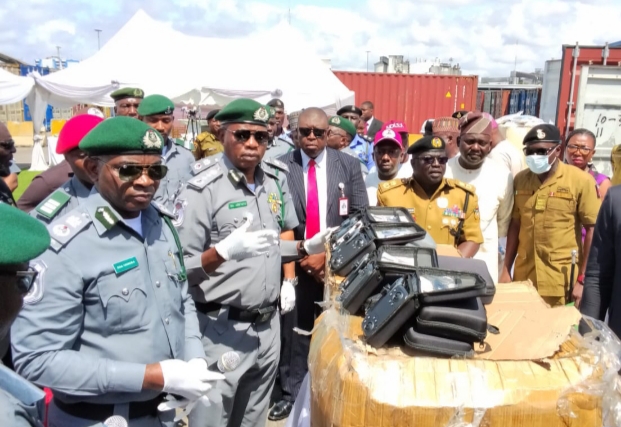
By Ranmilowo Ojalumo. The Nigeria Customs Service (NCS) has intercepted consignments containing 7,624kg of cannabis sativa, 169,998 bottles of codeine syrup, 108 high-definition dual-camera drones and several containers of expired products at the Apapa Area Command, with a combined duty paid value of N43.59 billion.
The Comptroller-General of Customs, Bashir Adewale Adeniyi, who disclosed this at a press briefing, said the seizures were the outcome of sustained intelligence-led operations by the Service in collaboration with other security and regulatory agencies.
Adeniyi said the seizures should not be viewed as an isolated incident, stressing that the Customs Service had a broader responsibility beyond revenue collection.
According to him, “The Nigeria Customs Service Act, 2023 charges this Service with more than the collection of revenue. It places on us the security of the supply chain, the protection of the border and the safety of what enters this country.”
He said the Service had strengthened its cargo profiling and risk assessment capabilities to detect consignments containing prohibited and dangerous goods, adding that criminal elements were increasingly concealing illicit items within otherwise legitimate consignments.
“What has changed in recent years is the method. Concealment is now built into otherwise legitimate consignments. Narcotics are packed among vehicle spare parts and used vehicles. Controlled drugs travel beneath household goods. Restricted equipment is declared as ordinary electronics,” he said.
Adeniyi said the NCS had deployed the B’Odogwu platform to enhance trade data analysis and cargo risk assessment, while an INTERPOL Data Centre was established at the Service’s headquarters in Abuja in July.
According to him, the centre, which is the eighth on the African continent, gives Customs officers access to more than 152 international databases.
He added that the Service had also deepened its operational cooperation with the National Drug Law Enforcement Agency (NDLEA), the National Agency for Food and Drug Administration and Control (NAFDAC), the Office of the National Security Adviser and international security partners.
Giving details of the seizures, the CGC said three containers intercepted at the Apapa Customs Area Command contained a combined 15,245 parcels of cannabis sativa weighing 7,624kg.
One of the containers, with number HAMU 3086682, contained 4,777 parcels of cannabis sativa weighing 2,388.5kg, alongside assorted automobile spare parts, coffee mix, oats and three vehicles.
Another container, FANU 1933352, contained 8,287 parcels of cannabis sativa weighing 4,145kg and three vehicles, while MSKU 3941778 contained 2,181 parcels weighing 1,090.5kg, in addition to foreign parboiled rice, automobile spare parts, lithium batteries, turmeric, mangala fish and butterfly fish.
The CGC said the cannabis seizures were the product of inter-agency collaboration involving the NDLEA and international security partners.
“That intelligence was analysed and acted upon here, through cargo profiling, documentary scrutiny and targeted examination by officers of this Service. I thank the NDLEA and our international partners for their cooperation,” he said.
Also intercepted was a 40-foot container, TCKU 7653306, containing 1,700 cartons of codeine syrup, amounting to 169,998 bottles, concealed under household items.
Adeniyi said the seizure was significant against the backdrop of concerns over the abuse of prohibited substances among young Nigerians.
“The abuse of prohibited substances like codeine among young Nigerians has been the subject of national concern for years, and its connection to violent conduct, to family breakdown and to the loss of productive lives is well documented,” he said.
He added, “A single container of this size would have supplied that trade for a considerable period.”
The Customs boss also disclosed the interception of 108 units of high-definition dual-camera drones extracted from container MSKU 9282528.
While acknowledging the legitimate uses of drones, Adeniyi warned that such equipment could pose security risks when placed in the wrong hands.
“Drones have lawful uses, and this Service has no quarrel with them. But equipment of this kind, in the wrong hands, becomes a means of surveillance, of reconnaissance and of delivery, and our security agencies have already met it in that role in the field,” he said.
He warned importers handling restricted and security-sensitive equipment to obtain the required approvals and documentation before shipment.
“Restricted and security sensitive equipment requires the appropriate security approvals, end-user certificates and documentation before clearance. Consignments of that character that arrive without them will be detained,” Adeniyi said.
He stressed that the nation’s ports would not be allowed to become channels through which security-sensitive capabilities reach individuals working against the country’s security.
The seizures also included 1,282 bales of used clothing from three containers. The containers, MRKU 6185100, MRKU 5535966 and SEKU 4685299, contained 425, 435 and 422 bales respectively.
Five other containers were found to contain expired products, including tomato ketchup, antiseptic liquid, vaginal tablets and disposable nappies.
According to Adeniyi, the affected containers were SUDU 7593139, loaded with expired tomato ketchup; PCIU 2834954, containing expired antiseptic liquid; ZCSU 8749546, loaded with expired vaginal tablets; and PONU 7890827 and MSKU 1524590, both containing expired disposable nappies.
The CGC said the importation of expired products constituted a serious threat to public health because many of the items were consumed by households or applied directly to the body.
“These are products applied to the body and consumed by households. Their importation after expiry places children, women and other consumers at risk of harm they have no means of detecting at the point of purchase,” he said.
Adeniyi said the seized items would be handed over to the relevant narcotics agencies for further action and closure.
He, however, assured legitimate traders that the Customs Service would continue to facilitate the movement of lawful goods, stressing that its enhanced scrutiny would be targeted at consignments, transactions and operators presenting identifiable risks.
“Scrutiny will fall on the consignments, transactions and operators that present identifiable risk,” he said.
To importers involved in false declaration, concealment, undervaluation or the importation of prohibited goods, the CGC warned that there would be no safe haven within the nation’s trade corridors.
“To those engaged in false declaration, concealment, undervaluation or the importation of prohibited goods, the position is straightforward: no port, border station or logistics channel will be permitted to serve as a safe haven,” he said.
He urged traders who were uncertain about the classification, valuation or origin of their products to make use of the Customs Advance Ruling mechanism before shipment.
He also encouraged compliant operators to join the Authorised Economic Operator programme, which he said offered more predictable clearance and fewer interventions where risk assessment justified it.
“Compliance is not an obstacle to business; it is an advantage over competitors who lack it,” Adeniyi said.
The Comptroller-General commended officers and men of the Apapa Area Command for their vigilance and professionalism, while appreciating the NDLEA, NAFDAC and international partners for their cooperation.
He reiterated that the ports must remain centres for lawful commerce, industrial growth and national prosperity rather than transit points for narcotics, controlled drugs, security-sensitive equipment or goods capable of endangering Nigerians.
“The Service will continue to hold that line, and we ask the public and the trading community to hold it with us,” he said.